
THE VACA DIXON Power Center
The Vaca Dixon Power Center is a progressive battery energy storage system (BESS) in Vacaville, California, is designed to support the state’s clean energy transition and the region’s growing demand for electricity.
Project Components
The Vaca Dixon Power Center will consist of two components:
Component 1
Vaca Dixon BESS
Component one will consist of a 57-megawatt, 1-hour (57-megawatt hour) battery energy storage solution (BESS) to support California’s decarbonization goals and growing electricity demand. The project will use a collection of one-hour batteries housed in 21 low-profile enclosures, a design that minimizes visual impact while ensuring safe and efficient operations.
Component 2
Arges BESS
Component 2 will include a 100-megawatt, 4-hour BESS (400-megawatt hours) with 50 enclosures of the same low-profile design. The project is ideally sited among similar infrastructure and will feature a creative landscape design including native shrubs and trees, improving the area’s overall beautification.
Project Features

244 MILLION GALLONS OF WATER AVOIDED

ENOUGH ELECTRICITY TO POWER 40,000 HOMES

200-250 JOBS CREATED

20 YEARS OF SAFE OPERATIONAL HISTORY
244 MILLION GALLONS OF WATER AVOIDED
ENOUGH ELECTRICITY TO POWER 40,000 HOMES
ENOUGH ELECTRICITY TO POWER 40,000 HOMES
Strategic Location
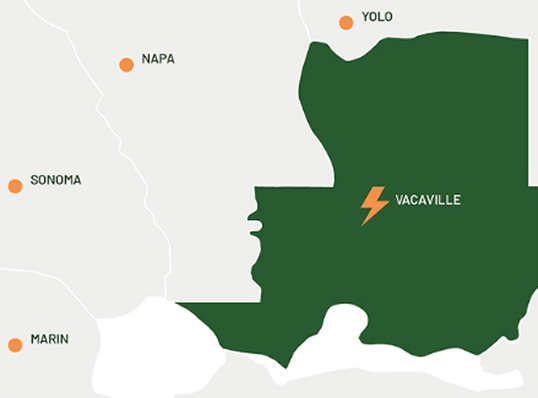
Located in Vacaville, California, adjacent to Interstate 80 and near the existing Vaca Dixon Peaker Plant and the PG&E Vaca-Dixon Substation, the project is strategically located to interconnect to the electrical grid and increase grid stability. The Vaca Dixon 57-megawatt hour BESS component is designed to operate in lieu of the Vaca Dixon Peaker Plant which will reduce emissions from gas fueled electricity generation. The overall project will help lower energy costs, improve grid reliability, and strengthen California’s transition to a more resilient, clean energy future.
Project Features
One of the most common questions we receive is: Why here? The answer is usually a combination of factors including:
1. Electricity Demand.
The location is near where more electricity is needed
2. Interconnection.
There is room on the transmission grid to accept and transport more electricity
3. Responsibly Sited.
The project site is well-suited for this infrastructure and any impacts can be mitigated
4. State Policy.
California energy policy has led to greater electricity use and important decarbonization goals
What makes the Vaca Dixon site ideal?

Located where there is a growing need for more electricity

The new infrastructure (transmission and batteries) will be placed in an area near to similar types of infrastructure

The battery system will operate in coordination with the existing natural gas generation; delivering a reliable and cost effective way to meet the demand for electricity
Meeting California's Leadership on Decarbonization
California and Middle River Power are moving fast to cut carbon and meet growing power needs. Our project helps deliver on that goal – adding clean energy while keeping the grid reliable, costs in check, and communities safe.
2015
SB 350
Set bold targets: 50% renewable electricity and major cuts to power plant emissions by 2030.
2016
2018
2022
Advanced
Clean Cards II
Rule adopted: all
new car sales must
be zero-emission
by 2035.
2023

The result
Project Events
The latest information on upcoming project milestones and opportunities to connect with the Vaca Dixon team.
OCTOBER 15, 2025
Community Open House
OCTOBER 15, 2025
Community Open House
OCTOBER 15, 2025
Community Open House

FAQ
How much power will the project generate?
The Vaca Dixon Power Center project will consist of two parts, or rather two components. Component 1 (Vaca Dixon BESS) will consist of 57-megawatts of 1-hour batteries within 21 low-profile enclosures. Component 2 (Arges BESS) will consist of 100-megawatts of 4-hour batteries within 50 enclosures of the same low-profile design. In total, the system will store enough power to provide electricity to around 2,000 homes for one full day.
Why was this site selected for a battery storage project?
This site was selected for two reasons: 1) The battery project has been co-located with an existing natural gas peaker plant. Once the battery system is installed, the batteries will store power generated during the day. In this area, that daytime power is often generated via solar farms. That renewable energy will be stored and dispatched later in the day, when electricity is in demand. This will help the natural gas peaker plant from needing to operate. 2) This site was selected because it is located in an area already used for power generation and electrical transmission. Our proposed project would be like-infrastructure to the substation, transmission lines, and power generation already occurring in the immediate area. The proposed project would operate with the existing natural gas peaker plant and the adjacent PG&E Vaca-Dixon Substation thereby reducing the length of gen-tie electrical lines needed to connect to the electrical grid via the PG&E facility. This represents responsible siting with a low overall impact to the project area.
The project will convert farmland to an energy project. How are you mitigating this impact?
As required by the California Energy Commission, we will be mitigating our use of this farmland through the State’s recognized conservation process. Through this process we will be conserving at least 10 acres of land through a land purchase organized by the Solano Land Trust. As we progress through this process, we will provide updates to the community.
What battery technology will be used at the Vaca Dixon Power Center?
The project will use commercially proven lithium-ion battery technology, similar to systems already operating safely across California and the United States. This technology is widely deployed to support grid reliability and integrate renewable energy.
Will the batteries be manufactured in the United States?
Battery components are sourced from global manufacturers, including U.S. and international suppliers, consistent with current industry practices. All equipment will meet applicable U.S. safety, environmental, and performance standards.
When is construction expected to begin and end?
Construction will begin after the project secures all required permits and approvals. The project has already initiated the permitting process with the California Energy Commission. After the application is deemed complete, the Commission’s review process typically takes about nine months. Once approval is granted, construction is expected to last approximately 18–24 months.
How long will the project operate?
The Vaca Dixon Power Center is designed to operate for approximately 30 years. At the end of its operational life, the facility can be upgraded, repowered, or safely decommissioned in accordance with regulatory requirements. Often times, communities are concerned that by the end of a project’s life, the original owner will no longer be in business, or simply not interested in the project’s end of life requirements. In this case, that will not be possible. A decommissioning bond will be put in place to ensure that even if Middle River Power is not operating in 30-years, there are funds reserved for the swift and safe deinstallation of the project.
How many workers will be needed during construction?
At peak construction, the project is expected to support approximately 130–140 construction jobs, generating significant local labor income and economic activity.
Where will construction workers be hired from?
The project will prioritize hiring qualified local and regional workers whenever possible and will utilize union labor and established construction contractors experienced with similar facilities in California.
How many permanent jobs will the project create?
We are eager to get to know the community, address questions, and learn how our work can support local goals. If you have a question or would like to set up a meeting to learn more about the project, please don’t hesitate to contact us.
Will the facility be staffed 24/7?
The site will not require full-time on-site staffing at all hours. However, it will be continuously monitored using advanced remote monitoring systems, with trained personnel available at all times to respond to any issues.
Does the project present a fire risk?
Like all energy infrastructure, the project has been carefully designed to minimize risk. Battery energy storage systems are subject to rigorous fire and safety standards and are regulated under strict state and local codes. Fire tests of these battery systems showed that in the unlikely event of a fire emergency, the fire would be contained within the battery container and extinguished using the fire suppression systems in every container. The site will be maintained to be free of groundcover that could fuel area wildfires. In fact, the battery system could serve as a valuable fire break, should a wildfire be moving through the area. It is important to note that this battery chemistry, the project’s layout with extensive spacing, and the latest in fire suppression technology represents advancements beyond technology that has seen fire incidents. Additionally, Middle River Power has hired a third-party safety engineer to help advise on our project’s design and serve as a training resource for area first responders. While we don’t anticipate an emergency, we want to ensure our local partners are confident that they could respond to an emergency at our site, safely, and successfully.
How will fire risks be minimized and addressed if an incident occurs?
The project includes multiple layers of fire prevention and protection, including advanced battery management and monitoring systems, fire-resistant equipment enclosures, on-site fire suppression systems, additional fire hydrants, coordination with local fire agencies, and specialized battery safety training for first responders.
Could a fire impact nearby roadways, including I‑80?
No. The facility is designed with setbacks, fire protection systems, and emergency response coordination to prevent impacts beyond the project site. The risk of off-site impacts is extremely low.
Does the project create electromagnetic fields (EMF)?
Like your cell phone or other devices, all electrical equipment produces some level of EMF, but levels associated with battery storage facilities are well below established safety thresholds and comparable to common household appliances.
How will the facility prevent vandalism or security breaches?
The site will include layered security measures such as perimeter fencing, controlled access, lighting, surveillance cameras, and remote monitoring.
What are the cumulative impacts when considered alongside other area projects?
Cumulative impacts are evaluated as part of the California Energy Commission’s environmental review process, which considers the combined effects of multiple projects in the area. It’s important to remember that battery project are essentially emissions-free energy storage facilities, designed to capture, store, and deliver renewable electricity when it is needed most.
Because battery energy storage systems do not generate electricity or produce air emissions during operation, long-term cumulative impacts related to air quality, greenhouse gases, noise, or traffic are minimal. Operational impacts are largely limited to the individual project sites and are subject to strict safety, fire protection, and operational requirements.
The primary overlapping impacts occur during construction and are temporary in nature, such as short-term construction traffic, noise, and site activity. These effects are time-limited, managed through construction controls, and mitigated to remain within applicable regulatory thresholds.
Importantly, when considered together, the projects provide cumulative benefits by improving grid reliability, reducing curtailment of renewable energy, and helping California meet its clean energy and climate goals, particularly during peak demand and extreme weather events.
How will the project benefit Vacaville and Solano County?
The project will generate construction jobs, long-term operational employment, local labor income, tax revenues, and community investments through partnerships with local organizations.
Will the project provide benefits to the local electrical grid?
Yes. Battery storage improves grid reliability by storing electricity when supply is abundant and delivering it when demand is highest. Daytime charging of the batteries will likely use renewable sources like solar power, which is widely available during the day but often underutilized because its generated when people are away from home and electricity demand is low. Because of energy storage projects like Vaca Dixon, that renewable power can be collected during the day, stored in the battery energy storage system, and then dispatched later in the day when power demand is high. Battery storage systems serve as a critical component in the utilization of renewable power. We’re proud that our proposed project will help support grid stability and California’s clean energy goals.
How does the project support renewable energy and emissions reductions?
Battery energy storage allows renewable energy to be captured when it is abundant and dispatched when demand is highest. The project is designed to charge primarily during periods of high solar production and discharge during evening and peak demand hours, when solar generation is no longer available. This improves grid reliability, reduces curtailment of renewable energy, and lowers emissions by decreasing the need for higher-emitting peaking generation.
Talk to the team
We are eager to get to know the community, address questions, and learn how our work can support local goals. If you have a question or would like to set up a meeting to learn more about the project, please don’t hesitate to contact us.

Dan Harmon
Vice President - Project Development
Jon Boyer
Director - Environmental, Health, and Safety
Robert Ray
Principal - Environmental Planner and Project Director

Maribeth Sawchuk
Principal - Community Relations